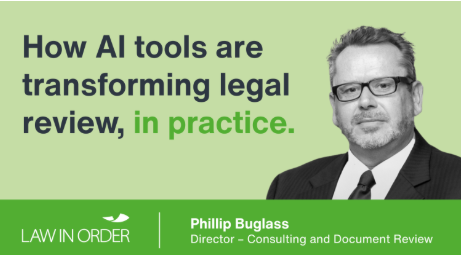

Our Chief Digital Officer, Murali Baddula, shares ours.
[1 ½ mins read]
As a Litigation Support Vendor (LSV), Law In Order constantly strives to provide the most efficient and effective client solutions. In eDiscovery, we always use the latest AI models to help you identify relevant documents and find sensitive documents to support matters quickly and efficiently.
Lately, one area of AI that’s captured the imagination of many industries, including the Legal Industry, is AI specifically in the form of ChatGPT and OpenAI.
While these technologies have the potential to revolutionise the way legal services are provided, it is important to approach them with caution. Law In Order firmly believes that AI should be used to augment human intelligence, not replace it.
Law In Order firmly believes that
AI should be used to augment
human intelligence, not replace it.
ChatGPT, a natural language processing technology, has shown promise in automating tasks such as contract review and document analysis. This can save time and resources for law firms, in-house legal teams and corporates. However, it is important to remember that AI is fallible. It is crucial to have human oversight to ensure accuracy and avoid potential legal issues.
Similarly, OpenAI’s advanced machine learning algorithms can assist in legal research and even predict the outcomes of cases. However, such predictions should not be relied on as the sole basis for decision-making. More than ever, legal professionals must consider the unique circumstances and nuances of each case.
Furthermore, ethical considerations of AI use in the legal industry must be addressed. For example, there is a risk that AI may perpetuate bias or discrimination. Legal professionals and LSV’s are responsible to ensure these technologies are used in a fair and just manner.
In summary, while Law In Order recognises the potential benefits of ChatGPT, OpenAI and other similar models, we believe they should be used as tools to enhance the work of legal professionals, not replace them. Approach these technologies with caution and ensure that they are used ethically and responsibly.